Driving in Japan: 5 Essential Rules You Should Know
Worried about driving in Japan? Discover the 5 key rules to plan your road trip safely and stress-free.
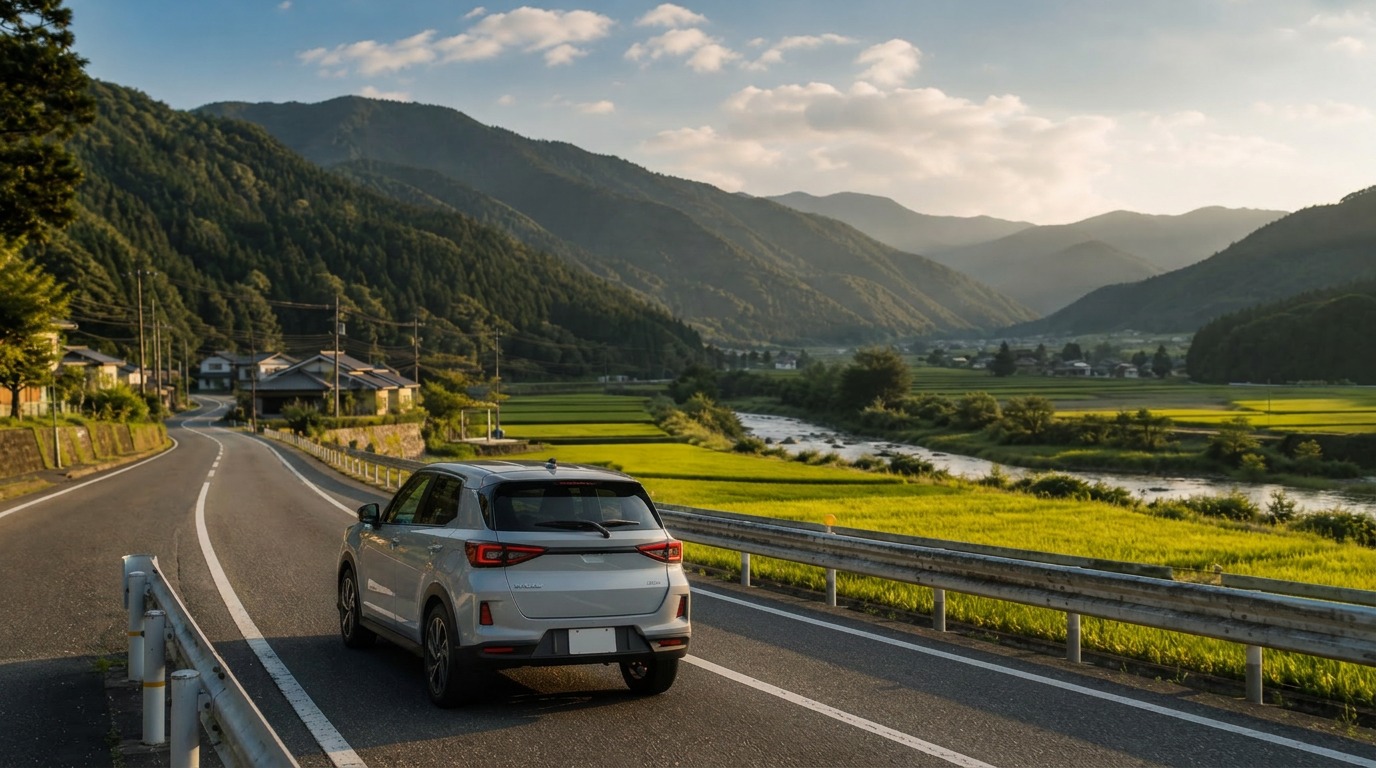
The 5 Most Important Rules for Driving in Japan: The Essential Guide Before Your Trip
Introduction: The Freedom of a Japanese Road Trip, Stress-Free Behind the Wheel
Driving in Japan means opening doors that trains never pass through.
Small roads winding between rice fields, hidden onsens in the mountains, coastal villages reached at sunset, the trunk full of souvenirs.
A car allows for a Japanese road trip that is quite different from the classic Shinkansen routes.
You choose your times, your breaks, your detours. You can spontaneously decide to stay an extra day in a valley you love or turn off to a beach you spotted on a map.
But before you get behind the wheel, a certain amount of concern is justified.
Left-hand traffic, Japanese traffic laws, signs sometimes in Kanji, toll highways, driver's license and JAF translation... it can mean many unknowns at once.
The good news is that driving in Japan is not "difficult," but mostly different.
Once a few rules are well understood, driving becomes smooth, almost more pleasant than in many European countries.
In this article, we present 5 essential rules you should master before your departure.
By the end, you'll know exactly what's really important for driving safely in Japan and what to watch out for during your first kilometers.
Rule 1 — Driving on the Left: Adapting Happens Faster Than You Think
The first thing that impresses is, of course, driving on the left side.
Japan adopted this direction for historical reasons, particularly due to British influence on the development of railways and the first cars.
The good news is that the brain adapts much faster than expected.
Most drivers report a phase of wavering for about one to two hours, followed by a gradual feeling of normalcy.
The cars are equipped with a steering wheel on the right side, which is logical since you drive on the left.
You are therefore on the outside of the road, with a clear view of the edge and the dividing lines.
The accelerator remains on the right, the brake in the middle, as everywhere.
The classic pitfalls do not appear on the large, straight stretches.
They hide more in the small everyday situations.
Leaving a supermarket parking lot and merging onto the main road requires a moment of concentration.
Your European reflex would lead you to merge right. But you must always merge left.
Take the time to look at the arrows on the ground; they are usually very clear.
T-junctions are another moment to watch out for.
Before turning, mentally repeat "I stay left."
This simple phrase avoids most placement errors.
Roundabouts are still rare in Japan, but they do exist.
You drive clockwise and give way to vehicles already in the roundabout, as elsewhere.
Again, focus on staying on the left when entering and exiting.
An amusing but initially confusing detail: In many Japanese cars, the levers for windshield wipers and turn signals are swapped compared to European models.
The result is that the first few kilometers often involve an unintended windshield wiper when you think you're signaling.
Don't worry, it happens to everyone, and you get used to it very quickly.
For your first kilometers, it's best to avoid the major thoroughfares through Tokyo or Osaka during rush hour.
It's better to start on a less busy road in the outskirts or rural areas.
A simple route between a smaller airport and your first countryside hotel allows you to gain confidence without pressure.
Finally, consider the psychological aspect.
In the first two days, you often deal with jet lag, fatigue, and excitement.
If possible, avoid driving at night at the start of your stay.
In the dark, landmarks change, and attention wanes more quickly.
In summary, driving on the left side in Japan requires some concentration at first, but adaptation happens much faster than you think.
After a few hours, you'll hardly think about which side of the road you're on.
Rule 2 — The Driver's License and Its Official JAF Translation
The second essential rule, often underestimated: the administrative part.
In Japan, your international driver's license doesn't count, but your national driver's license together with an official translation does.
For French, Belgian, Swiss, German, and Monegasque nationals, the international driver's license is not valid for driving in Japan.
This is an important detail that surprises many travelers.
To drive in Japan, you must always have three documents with you:
- Your original national driver's license.
- The official JAF translation of this license.
- Your passport, which proves your identity and entry date into the country.
The JAF, Japan Automobile Federation, is the only organization authorized to issue a recognized translation.
"Homemade" translations, created by a friend, an unrecognized translator, or an automatic tool, are not accepted by the police or rental agencies.
If you're checked without a valid JAF translation, you're considered an unauthorized driver.
Penalties can range from a fine to more severe consequences in the event of an accident, not to mention insurance issues.
Another crucial point: the validity.
The JAF translation is generally valid as long as your driver's license itself remains valid.
However, for driving with a foreign license, the rule is a maximum of one year from the entry date into the country.
Beyond that, further steps are necessary, such as converting to a Japanese driver's license.
You can apply for this translation in two ways:
- Directly in Japan by visiting a JAF office or using the local system.
- Or through a specialized service from abroad, in collaboration with entities like DrivinJapan, before your departure.
The first option may seem more economical, but it forces you to deal with the procedure during your trip, with variable waiting times.
In case of rejection or a problem with your application, you risk not being able to rent a car in time.
The second option allows you to plan in advance, often 30 to 60 days before departure.
You send in your documents, your application is reviewed, and then forwarded to JAF from Japan.
It's a bit more expensive but saves you the stress of an administrative procedure on-site.
A friendly tip: Treat the issue of the driver's license and JAF translation like your plane ticket.
Without these documents, your road trip in Japan simply won't take off.
Rule 3 — Speed Limits and Rule Enforcement
Japan is a country of rather calm drivers.
To keep the experience pleasant, it's important to observe local speed limits, which are sometimes lower than in Europe.
In residential areas, you'll often see limits around 30 to 40 km/h.
The streets are narrow, with many pedestrians and bicycles.
Children move around independently quite early, hence this caution.
In normal urban areas, the limit is usually between 50 and 60 km/h.
Signs indicate the maximum speed, and traffic lights are frequent.
On rural roads outside towns, the limit is often 60 km/h.
This may seem slow, but passing through villages, curves, and weather conditions justify this caution.
On highways, the limit is generally between 80 and 100 km/h, depending on the section.
Some newer sections may be slightly higher, but it remains relatively moderate compared to other countries.
Speed checks are numerous, fixed or mobile.
They are often marked but not always obvious to foreigners.
The Japanese police are particularly strict with significant violations, especially over 20 km/h above the limit.
The crucial point, however, remains drinking and driving.
Tolerance is nearly zero.
The legal limit is about 0.03 g/L of blood, compared to 0.5 g/L in France.
In practice, this means that even a single glass can get you into trouble.
Penalties are harsh: very high fines, revocation of the Japanese driver's license for residents, possible imprisonment in the event of an accident, and severe consequences for passengers or even those who allowed you to drive after drinking.
Random checks are frequent at night, especially near nightlife districts.
The simple rule to follow is clear: If you drive, don't drink.
No "one glass is okay," no "just one cocktail."
If you want to enjoy a dinner with sake, leave the car and take a train, taxi, or VTC.
Practical tip: Plan "car-free" evenings in advance during a road trip.
Plan a dinner near your accommodation, enjoy it, and set off again the next day, completely clear-headed.
Rule 4 — The Unique Aspects of Japan's Traffic Laws You Should Definitely Know
Beyond speed limits, the Japanese traffic laws contain some unique aspects that might surprise a foreign driver.
Let's start with traffic lights.
A flashing red does not mean "slow down," but rather STOP.
You must come to a complete stop, check that no vehicle is coming, and then proceed.
A flashing orange is more like "proceed with caution."
You continue driving but are ready to stop if necessary.
At intersections without lights or with unfamiliar signs, the implicit rule is to slow down significantly or even stop.
The average Japanese driver is not in a hurry.
Even if you theoretically have the right of way, it's better to pass through these areas gently.
Pedestrian crossings are sacred.
If a pedestrian is standing at the edge and clearly ready to cross, you must stop.
It's not uncommon for cars to stop well before the crossing to allow people to cross peacefully.
The horn is used very sparingly.
Honking out of anger or to "urge" someone forward is frowned upon.
It's used only in immediate danger or sometimes for a small, discreet "thank you" on a mountain road.
In rural areas, you will encounter some intersections, sometimes at night when traffic is light, with flashing yellow or red lights.
Do not ignore them under any circumstances.
They indicate potentially accident-prone areas with poor visibility or crossing traffic.
Another element not to be overlooked: bicycles.
In Japan, they are allowed to ride on both sidewalks and roadways, depending on the location.
They sometimes come from the right, sometimes from the left, sometimes in the middle.
Always slow down near schools, train stations, and shopping centers.
The turn signal is used very rigorously.
Even for a small lane change, drivers signal their intention in advance.
Not doing so is both dangerous and socially frowned upon.
On the highway, the same rule applies as in your country, but reversed.
You drive in the left lane, overtake on the right, and then return to the left.
Staying in the right lane continuously is strongly discouraged.
Reflex to adopt: If you're not sure who has the right of way, choose the most cautious solution.
In Japan, driving is a space of cooperation, not competition.
Rule 5 — Highways, Tolls, and Using the ETC
Japan has a dense, toll-based, and very well-maintained highway network.
For a road trip in Japan, you will almost inevitably use these expressways, especially when connecting multiple large regions.
The highways are comfortable, well-lit, and well-signposted.
However, they are expensive compared to European standards.
On average, you can expect about 25 yen per kilometer, which at the current rate is about €0.16.
A 200 km journey can quickly cost several dozen euros in tolls.
To make life easier for drivers, Japan uses an electronic toll system called ETC (Electronic Toll Collection).
Most rental cars are equipped with an ETC device.
You simply insert a special card to pass through the barriers without coming to a complete stop.
When renting, remember to request an ETC card.
Some rental companies provide them for free, while others charge a small fee.
In return, you often benefit from discounted rates, with savings of 20 to 30% on certain routes.
If you don't use the ETC, you can of course use the manual booths.
You then pay in cash or by credit card, depending on the station.
The signs clearly indicate the ETC lanes and the "normal" lanes, with different colors.
The service areas are part of the travel pleasure.
There is a distinction between SA (Service Area), larger ones with restaurants, shops, sometimes showers, and PA (Parking Area), smaller ones for a quick break.
The toilets are generally spotless, which is a pleasant contrast to some other countries.
For longer stays, there are highway passes for tourists, like the Japan Expressway Pass or regional passes (Hokkaido, Kyushu, etc.).
They often work for a limited duration, with unlimited access to a specific network, in exchange for a flat fee.
For a long road trip, these passes can significantly reduce the overall cost.
Travel recommendation: Avoid main routes like the Tomei (Tokyo–Nagoya) or the Meishin (Nagoya–Osaka) during peak hours.
If possible, plan your long highway drives for late morning or early afternoon.
Some Bonus Tips for Your First Kilometers
Beyond the major rules, a few simple actions can make your start significantly more comfortable.
- Test the car in a parking lot before setting off. Check the indicators, wipers, lights, handbrake, and fuel cap.
- Set the GPS to English. Most modern cars in Japan offer an English interface. Otherwise, use your smartphone with a navigation app.
- Plan to have 5,000 to 10,000 yen in cash for small parking lots, secondary toll booths, or vending machines.
- Install the Google Translate app and test the camera mode to quickly translate a sign or message on a screen.
- A local SIM card or Pocket WiFi makes things much easier for GPS, translation, and finding service areas.
- Note down the emergency numbers: 110 for the police, 119 for fire and ambulance.
- Keep a photo of your driver's license and your JAF translation on your phone as a backup, even though only the original counts.
These small details aren't dreamy, but they're what turn a travel day into a smooth experience rather than a series of micro-stress situations.
The Most Common Mistakes Foreign Drivers Make in Japan
Even with good preparation, foreign drivers often make the same mistakes.
Knowing them in advance can help you avoid them.
Forgetting that the turn signal and windshield wipers are swapped.
Result: Windshield wipers on a sunny day. Funny the first time, less so in the middle of an intersection.Not signaling all lane changes.
In Japan, the turn signal is both a social and legal communication tool. Use it generously, even for small movements.Honking out of anger.
This is frowned upon. Japanese people prefer patience and distance over auditory conflicts.Parking on the wrong side of the street.
Parking on the right side, against the direction of traffic, is generally prohibited and quickly penalized, especially in the city.Driving in sandals or flip-flops.
This is explicitly forbidden by many rental companies and can be considered dangerous or even penalized.Not anticipating right of way at intersections.
Some intersections are less clear for foreigners. Systematically slow down and observe the behavior of others.Thinking that an international driving permit is sufficient.
Many travelers discover too late that they need a JAF license translation. Don’t be one of them.Underestimating travel time in mountainous regions.
A map may show 80 km, but between curves, speed limits, and photo stops, the drive can take much longer than expected.
And if You Want to Go Further?
If these 5 rules seem clear to you, you already have a solid foundation to drive in Japan and feel safe.
The next logical step is to plan your route and choose the regions that match your travel style.
On Japan-by-car.com, you’ll find detailed travel guides by region: Hokkaido in summer, Japanese Alps, Kyushu, Shikoku, coastal peninsulas, etc.
Each article describes the most pleasant routes, realistic daily distances, and recommended stops.
If you haven’t sorted out your Japanese driver’s license yet, now is the right time to do so.
Our partner DrivinJapan allows you to obtain the official JAF translation directly from abroad before your departure, without having to do anything on-site.
Finally, if you want to receive our new routes, driving tips, and updates on local regulations, you can sign up for the Japan-by-car newsletter.
In it, we share road trip ideas, travel stories, and very concrete tips for German-speaking drivers.
FAQ: Your Most Common Questions
1. Do you need special insurance to drive in Japan?
Basic insurance is included in most rental agreements, but it often only covers major damages.
We recommend adding an option to reduce the deductible or an additional insurance that also covers minor damages, theft, and towing.
It's a reasonable extra cost compared to the expenses of a road trip in Japan.
2. Is my German driver's license valid in Japan?
Yes, but only if presented with an official JAF translation.
The international driving permit alone does not allow German, French, Belgian, or Swiss nationals to drive in Japan.
Always carry your national driver's license, the JAF translation, and your passport with you.
3. What is the difference between the JAF translation and the international driving permit?
The international driving permit is a generic translation valid in certain countries.
The JAF translation is an official Japanese document recognized by the police, insurers, and rental companies.
For driving in Japan, the JAF translation is what counts, not the international driving permit.
4. How much does a tank of gas cost in Japan?
The price varies by region and type of fuel, but generally ranges from 130 to 170 yen per liter.
For a small Japanese car, a standard fill-up costs about 5,000 to 7,000 yen.
Gas stations clearly display their prices, often slightly higher on the highway than in the city.
5. Can you drive in Japan with a provisional license?
In principle, yes, as long as your provisional license is valid and accompanied by a JAF translation.
However, some rental companies require a minimum duration of the license (for example, one year).
It is therefore important to check the rental conditions before booking your vehicle.
6. What to do in case of an accident in Japan?
In the event of an accident, even a minor one, first secure the accident site.
Then call the police at 110 to create a report, which is essential for insurance.
Immediately inform your rental agency and follow their instructions while taking photos of the scene and damages.
7. Are Japanese roads well signposted in English?
The main roads, highways, and city entrances are generally well signposted in Japanese and Latin characters.
However, in rural areas, some signage remains only in Kanji.
An English GPS and a navigation app on your smartphone make things much easier.
8. How many kilometers can you drive per day on a Japanese road trip?
To stay comfortable, you should generally aim for between 150 and 250 km per day, especially if you plan to do some sightseeing along the way.
Beyond 300 km, the day quickly becomes tiring, especially in the mountains or on winding roads.
It's often better to add an extra overnight stay than to turn your road trip into a marathon.
Conclusion: 5 Rules to Turn Concerns into Driving Pleasure
Driving in Japan is not a challenge, but a different way to discover the country.
If you keep these 5 essential rules in mind, you'll turn concerns into confidence:
- Accept left-hand traffic and give yourself a few hours to adjust.
- Address the issue of the Japanese driver's license and the JAF translation well before departure.
- Observe speed limits and adopt zero tolerance for drinking and driving.
- Integrate the specifics of the Japanese traffic regulations, from crosswalks to flashing traffic lights.
- Understand the highway, toll, and ETC system to manage your budget and routes.
Driving in Japan isn't more complicated; it's simply more regulated and calmer.
Once these rules are internalized, the road becomes a pleasure, and your road trip turns into a series of discoveries rather than a source of stress.
If you plan to rent a car, start by preparing your driver's license and JAF translation.
Then, all you need to do is choose a route from our travel guides, set your GPS... and enjoy the unique freedom of a Japanese road trip.
Frequently asked questions
Do you need special insurance to drive in Japan?
Basic insurance is included in most rental agreements but often covers only the essentials. We recommend getting excess reduction or additional insurance that covers vehicle damage, third parties, and towing costs. Always check exclusions and the excess amount before signing your rental contract.
Is my German driver's license valid in Japan?
Your German driver's license is only valid in Japan when presented with an official translation by JAF, the Japan Automobile Federation. An international driving permit is not sufficient for German citizens. Always carry your national license, the JAF translation, and your passport.
What is the difference between the JAF translation and the international driving permit?
The international driving permit is a standardized translation of your license for certain countries. The JAF translation is an official Japanese document from the Japan Automobile Federation, recognized by police, rental companies, and insurers. For Germans, only the JAF translation is legally valid for driving in Japan.
How much does a full tank cost in Japan?
Gas prices vary by region but typically range from 130 to 170 yen per liter for regular gasoline. Filling up a small Japanese compact car usually costs between 5,000 and 7,000 yen. Gas stations are plentiful, even in rural areas, but plan ahead for very remote regions.
Can you drive in Japan with a provisional license?
Yes, a provisional license can generally be used if it is fully valid in your home country and accompanied by an official JAF translation. However, some rental companies may require a minimum license holding period, such as one or two years. Always check the conditions of your chosen rental company before booking.
What should you do in case of an accident in Japan?
Stay calm, secure the accident site, and call the police at 110, even for minor accidents. Immediately inform your rental company, which will guide you on the next steps. Do not sign documents you do not understand, and take photos of the scene, license plates, and damages. A police report is often required for insurance claims.
Are Japanese roads well signposted in English?
Most major roads, highways, and city exits are well signposted in Japanese and the Latin alphabet, often with English translations. However, in rural or mountainous areas, signage may be almost exclusively in Japanese. It's highly recommended to use an English-language GPS and a smartphone navigation app with offline maps.
How many kilometers can you drive per day on a Japanese road trip?
To enjoy your road trip without excessive fatigue, aim for 150 to 250 kilometers per day. This usually equates to 3 to 4 hours of driving, considering speed limits, village crossings, and breaks. Beyond 300 kilometers, the day could become very tiring, especially if you plan to visit sights along the way.