Gasoline in Japan: Prices, Fuel Types, Gas Stations, and True Road Trip Costs
Gasoline prices in Japan from January to May 2026, fuel types, comparison with France, gas station accessibility, and the economic benefits of a shared road trip versus the shinkansen.
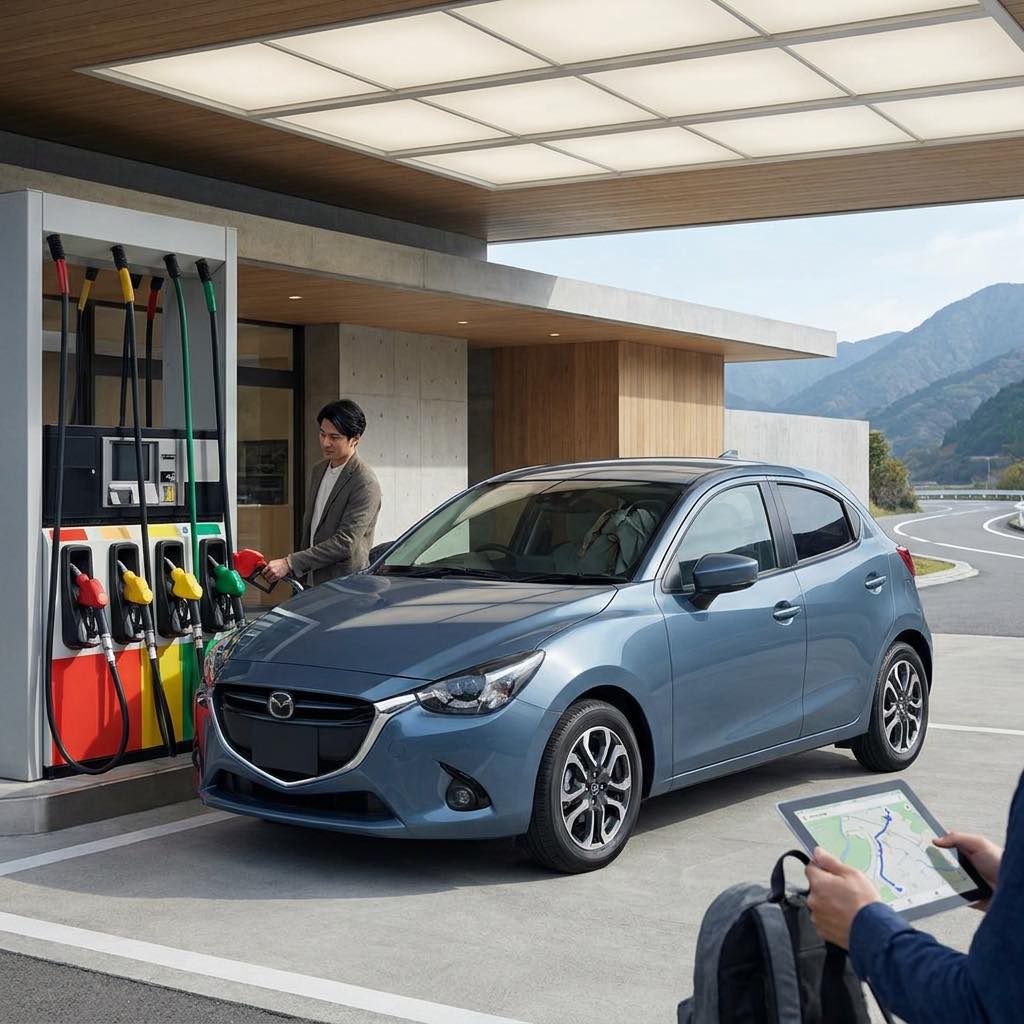
Gasoline in Japan: Prices, Types of Fuel, Gas Stations, and the True Cost of a Road Trip
Introduction
When thinking about driving in Japan, we often ask the same questions: Is gasoline expensive? Are gas stations easy to find? Which fuel should I choose? And most importantly, in the end, is driving really worth it compared to taking the train?
These questions are valid because a road trip in Japan isn't just about the rental price. Fuel, types of gasoline, the density of gas stations, and the real cost per person significantly impact the overall budget.
The good news is that in Japan, refueling is generally straightforward. The network of gas stations is still well-established, major brands are easy to spot, and the fuel prices observed from early 2026 to the end of May 2026 remain significantly lower than those in France.
In other words, if you're traveling with others, a car can become not only more flexible but also more economically attractive than the shinkansen on many routes.
Are gas stations easy to find in Japan?
Overall, yes.
In Japan, you can easily find gas stations in:
- major cities;
- urban outskirts;
- major roads;
- highways;
- and most populated regional areas.
The most visible brands include ENEOS, apollostation, and Cosmo, which make up a large part of the Japanese gas station landscape.
On highways, service and rest areas also allow you to refuel on long journeys. However, as in many countries, some rural or mountainous areas have a lower density. It's better not to wait until you're almost empty when leaving the main roads.
In practice, with Google Maps, a rental GPS, or the visual cues of major brands, a road trip in Japan generally doesn't pose any particular difficulty in finding fuel.
Types of Fuel in Japan
In Japan, the three main types of fuel to know are:
- Regular: This is the standard gasoline, most common for the majority of rental cars.
- Premium: Gasoline with a higher octane rating, used for certain specific vehicles.
- Diesel: For diesel models, less common in standard tourist rentals.
The important point for travelers is simple: most standard rental cars use regular gasoline. This is generally the fuel you should ask for unless otherwise indicated by the rental company or a specific label on the vehicle.
Regular is sometimes indicated as レギュラー, premium as ハイオク, and diesel as 軽油. Remembering these three words can be useful when stopping at a local gas station.
Gasoline Prices in Japan from January 2026 to May 2026
Between January 2026 and May 2026, Japanese prices fluctuated within a relatively contained range, thanks in part to public measures aimed at keeping gasoline around 170 yen per liter on a national average.
At the end of May 2026, the observed levels were close to:
- Regular: about 169.2 yen/L (or 0.91 €/L)
- Premium: about 180.1 yen/L (or 0.97 €/L)
- Diesel: about 158.5 yen/L (or 0.85 €/L)
External reports in May 2026 also show regular around 169.4 yen/L and diesel around 158.8 yen/L, confirming this general range.
For the evolution from January to May 2026, a simple idea can be retained:
- Japan generally stayed within a range of around 167 to 170 yen/L for regular in spring 2026;
- the support policy explicitly aimed to keep the national average near 170 yen/L;
- differences between stations exist, but the national trend remained relatively clear.
Comparison with France
This is where the contrast becomes very telling.
In France, in May 2026, observed prices were around:
- SP95: about 2.08 to 2.11 €/L
- Diesel: about 2.12 to 2.16 €/L
At the same time, Japan displayed:
- about 169 to 170 yen/L for regular gasoline
- or about 1.05 to 1.07 USD/L according to reported conversions;
- and diesel around 158 to 159 yen/L.
Even without fixing an exact euro/yen conversion for each week, the message is clear: road fuel was significantly cheaper in Japan than in France in spring 2026.
Why Gasoline Seems Cheaper in Japan
The answer isn't just a simple matter of the raw market.
In spring 2026, the Japanese government explicitly supported measures to stabilize the price of gasoline around 170 yen/L nationally. This policy played an important role in maintaining a relatively moderate price level compared to other developed countries.
In other words, if gasoline seems more accessible in Japan than in France at the same time, it's not just because the country is "naturally cheaper," but also because a public stabilization framework influenced the observed prices.
Refueling in Japan: Simple or Complicated?
For a traveler, refueling in Japan is generally simpler than you might imagine.
There are two main types of stations:
- staffed stations;
- self-service stations.
In staffed stations, you often just need to stop, indicate the type of fuel, and ask for a fill-up. In self-service stations, the process is more like what we know in Europe: choose the fuel, pay, then fill up.
A few Japanese words can help:
- Mantan: full tank
- Regular: standard gasoline
- Haioku: premium
- Keiyu: diesel
But in tourist areas or with a translation app, the procedure remains generally manageable.
How Much Does a Road Trip in Japan Cost in Fuel?
To get a simple idea, let's take a compact car consuming about 6 L / 100 km.
In Japan
With regular gasoline at about 169 yen/L, a journey of:
- 500 km consumes about 30 L
- or about 5,070 yen (or approximately 27.39 €) in fuel.
In France
With gasoline at about 2.10 €/L, the same journey of:
- 500 km still consumes about 30 L
- or about 63 € in fuel.
The contrast is clear: for the same distance, the pure fuel cost is significantly lighter in Japan than in France.
Distance Comparison: Japan vs France for the Same Distance
Let's consider three simple distances with a car consuming 6 L / 100 km.
For 500 km
- Japan: 30 L × 169.2 yen ≈ 5,076 yen (about €31)
- France: 30 L × €2.10 ≈ €63
For 1,500 km
- Japan: 90 L × 169.2 yen ≈ 15,228 yen (about €81.92)
- France: 90 L × €2.10 ≈ €189
For 3,000 km
- Japan: 180 L × 169.2 yen ≈ 30,456 yen
- France: 180 L × €2.10 ≈ €378
Even considering Japanese tolls, this fuel base makes driving very competitive if you share costs with others.
Carpooling vs the Shinkansen
This is often where the calculation changes completely.
For a single person, the shinkansen can remain very competitive on certain major routes. But as soon as you are 3 or 4 travelers, the economic logic starts to shift.
Why?
Because a car allows you to share:
- the rental;
- the fuel;
- the tolls;
- and sometimes even avoid certain taxis or local transfers.
Conversely, the train adds up tickets per person. And when the itinerary deviates from major routes, you often need to add:
- regional trains,
- buses,
- taxis,
- or time constraints.
In other words, the larger the group, the more appealing the car becomes, especially for a regional, flexible, or rural itinerary.
Three Example Itineraries with Timing
The figures below are editorial estimates to illustrate the economic logic. They do not replace an exact quote.
Itinerary 1 — 7 days: Mount Fuji and Izu
Example:
- Tokyo
- Kawaguchiko
- Hakone
- Izu Peninsula
- return to Tokyo
Indicative distance: 500 to 700 km depending on detours.
For 4 people, the car allows:
- total freedom to stop;
- luggage in the trunk;
- access to less well-served areas;
- and shared transport costs.
On such a route, the car is often more appealing than the equivalent in shinkansen + local trains + buses + taxis, especially if you want to visit several points outside the main stations.
Itinerary 2 — 14 days: Kansai, Kii, Partial Shikoku
Example:
- Osaka
- Nara
- Wakayama
- Kii Peninsula
- Tokushima
- Takamatsu
- return to Kansai
Indicative distance: 1,200 to 1,800 km.
Here, the car becomes even more relevant as the itinerary leaves the ultra-dense main routes. The flexibility provided by a vehicle makes it easier to connect accommodations, coasts, villages, and natural areas.
For 3 to 4 people, the shared cost often becomes very rational compared to stacking regional train tickets.
Itinerary 3 — 30 days: Grand Road Trip Hokkaido or Multi-Region Japan
Example:
- Circular Hokkaido in summer or
- Tokyo, Nagano, Kanazawa, Kyoto, San’in, Partial Kyushu
Indicative distance: 3,000 to 4,500 km depending on the route.
Over a month, the advantage of the car is even stronger if you seek:
- autonomy,
- flexibility,
- spontaneous stops,
- and a journey less dependent on schedules.
Fuel costs increase mechanically, but they remain manageable once shared. And above all, on a long trip, the car provides access to a much broader Japan than just the main rail corridors.
Comparison: 7 Days, 14 Days, 30 Days
Over 7 Days
For 2 people, the gap with the train depends greatly on the itinerary.
For 3 or 4 people, the car often starts to become very appealing if the program includes several regional stops.
Over 14 Days
At this stage, the shared car often takes the lead on an itinerary off the main routes, as the total train cost for several people rises quickly, especially if secondary connections are added.
Over 30 Days
On a long trip, the car is not just a matter of price. It becomes a more complete travel tool. And with fuel more accessible than in France, it remains economically viable for groups despite the accumulated kilometers.
Key Points to Consider Before Making Your Calculation
To seriously compare car and train, you need to consider:
- the number of travelers;
- the type of region visited;
- the number of bags;
- the share of rural areas;
- the need for flexibility;
- and the indirect costs avoided thanks to the car.
Fuel alone doesn't decide everything.
But in 2026, it clearly plays in favor of the road trip, especially compared to France and especially in a shared cost logic.
FAQ: Your Most Frequent Questions
1. Are gas stations easy to find in Japan?
Yes, generally very easy, especially on major routes, near cities, and on popular itineraries.
2. What are the main fuels in Japan?
Regular, premium, and diesel.
3. What was the average price of gasoline in Japan in spring 2026?
Around 169 to 170 yen/L for regular, around 180 yen/L for premium, and around 158 to 159 yen/L for diesel.
4. Is gasoline cheaper in Japan than in France?
Yes, significantly in spring 2026.
5. Why does fuel seem cheaper in Japan?
Because public measures have helped maintain prices around 170 yen/L on a national average.
6. What fuel should you put in a rental car?
Most often regular, unless otherwise indicated by the rental company.
7. Is carpooling more appealing than the shinkansen?
Very often yes, from 3 or 4 people, especially for regional or flexible itineraries.
8. Is a road trip in Japan cheaper than in France for the same distance?
In pure fuel terms, yes, the cost per kilometer is generally lower in Japan than in France in 2026.
Conclusion
Filling up in Japan is neither particularly complicated nor particularly stressful. Gas stations are numerous, fuels are easy to identify, and the price per liter remains, in spring 2026, significantly more favorable than in France.
This is an important factor, as it completely changes the budgetary perspective of a road trip.
For groups, a rental car with shared expenses can quickly become more appealing than the shinkansen, especially once you leave the main routes and seek a freer, more flexible journey rich in detours.
In summary, if you're traveling as a couple, with friends, or family, fuel in Japan is not a barrier to a road trip. It often becomes one of the best economic arguments.
Frequently asked questions
Is it easy to find gas stations in Japan?
Yes, gas stations are generally easy to find in Japan, especially near cities, major roads, and highways. The most visible brands include ENEOS, apollostation, and Cosmo.
What are the main types of fuel in Japan?
The main fuels in Japan are regular, premium, and diesel. Regular is the most common fuel for most rental cars.
What was the average gasoline price in Japan in spring 2026?
In spring 2026, the national average price for regular gasoline in Japan was around 169 to 170 yen per liter, about 180 yen for premium, and approximately 158 to 159 yen for diesel.
Is gasoline cheaper in Japan than in France?
Yes, in spring 2026, gasoline was significantly cheaper in Japan than in France, where average prices exceeded about 2.08 euros per liter for gasoline and 2.12 euros per liter for diesel.
Why does fuel seem cheaper in Japan?
The price levels observed in Japan in 2026 were influenced by public measures aimed at stabilizing prices around 170 yen per liter for gasoline.
Is a shared car more economical than the shinkansen?
In many cases, yes. With 3 or 4 travelers, a rental car with shared fuel costs can be more competitive than multiple shinkansen tickets, especially for regional or flexible routes.
What fuel should you use in a rental car in Japan?
Most standard rental cars use regular gasoline. However, it's essential to check the vehicle's label or the rental company's instructions before refueling.
Is a road trip in Japan cheaper than in France for the same distance?
In terms of pure fuel cost, the cost per kilometer is often lower in Japan than in France in 2026, as the price per liter was significantly lower.