JAF License Translation in Japan: How to Send Compliant Photos of Your Driver's License
To obtain the official translation of your license and drive legally in Japan, it's essential to send compliant photos or scans of your driver's license. Here's the complete guide to submitting the right document, in the right format, and avoiding delays caused by blurry, cropped, or incomplete images.
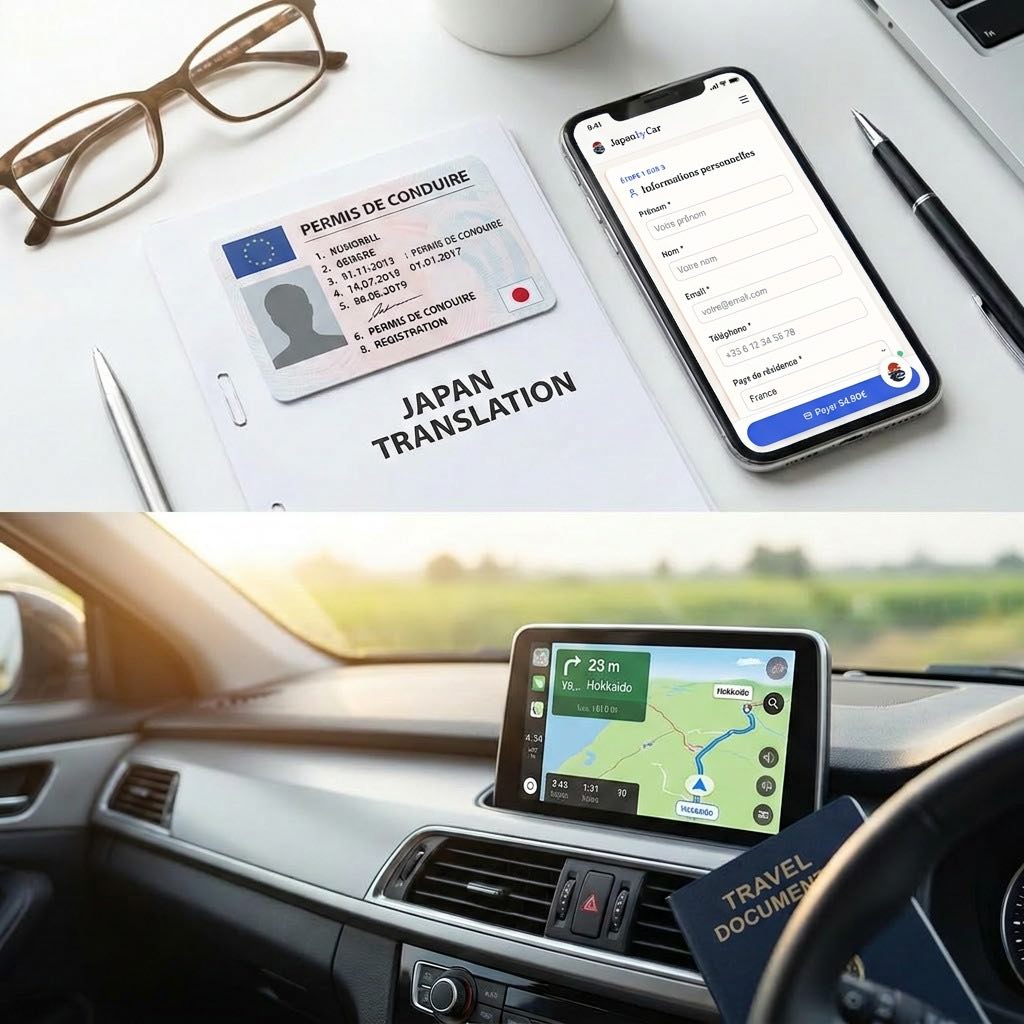
JAF License Translation in Japan: How to Send Compliant Photos of Your Driver's License?
To legally drive in Japan with a license issued in countries such as France, Belgium, Switzerland, Germany, Monaco, or Taiwan, you generally need to present the original license along with its official Japanese translation when applicable; JAF outlines this procedure on its official website and through its online application service. As part of this process, JAF specifies that the required documents include images of the front and back of the currently valid foreign license.
In recent months, feedback has shown that many delays are simply due to non-compliant photos or scans. The goal of this guide is to improve the quality of submitted documents by clearly explaining which document to send, how to photograph it, and which errors to avoid to minimize processing delays.
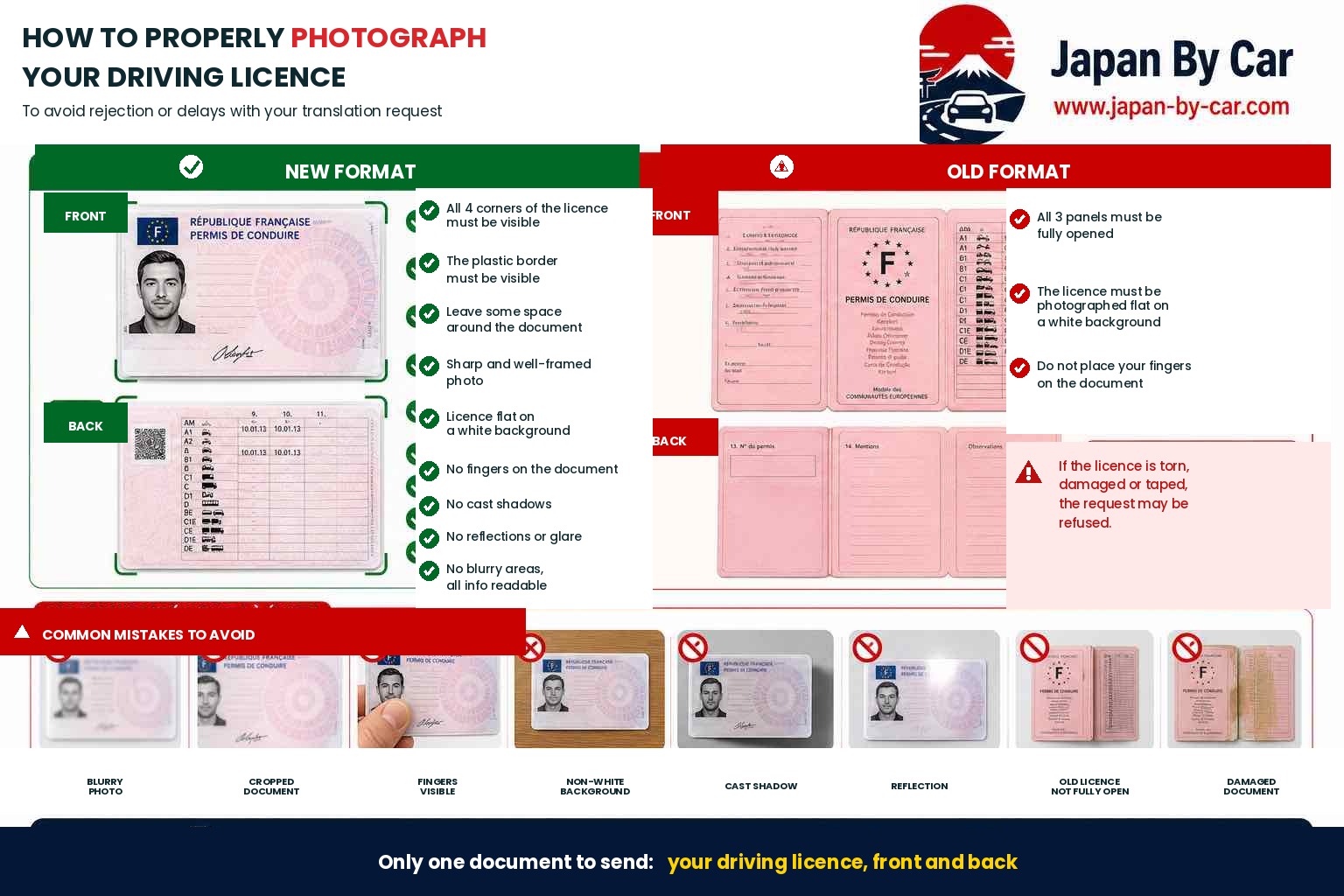
Infographic to Help You Properly Prepare the Upload of Your Valid Driver's License Front and Back
Key Points
In most cases, only one document needs to be submitted: your driver's license front and back.
If the images are blurry, cropped, pixelated, or incomplete, the process may be delayed.
Which Document Should Be Sent for JAF Translation?
For a standard request, the document to be submitted is the currently valid driver's license, with the front and back. JAF documentation explicitly mentions that the expected files include the image data of the front and back of a currently valid foreign driver's license.
In practical terms, this means you should not send a partial photo, a too-tight framing, an imprecise montage, or a document with some unreadable information. The cleaner, more readable, and complete the images are, the more smoothly the application can be processed without additional exchanges.
General Rules for All Photos or Scans
The basic guidelines are the same for all licenses, regardless of their format. The provided infographic reminds that the document must be fully visible, clear, readable, photographed in color, and without any elements obstructing the information.
General Checklist
- The document must be photographed or scanned in color.
- The 4 corners of the license must be visible.
- The document must not be cropped.
- All information must be readable and visible.
- The file must not be blurry or pixelated.
- There should be no shadow or reflection on the document.
- The license should be placed flat on a white background.
- Do not place your fingers on the document.
Key Points
A good photo of a license is a simple, clear, and complete photo: white background, good lighting, document flat, no fingers, no reflection, and no cropping.
New Format: How to Photograph the Card License
For new licenses, especially the French card format license, you need to submit the front and back with a slightly wide framing to show the entire document. The most important point is that the plastic border must be fully visible, which requires leaving some space around the card.
The license should be placed flat on a white background, with even lighting and no reflection. The 4 corners must be clearly visible, without cropping, and all information must remain perfectly readable.
New Format Checklist
- Send the front and back of the license.
- Leave space around the document.
- Make the entire plastic border visible.
- Ensure the 4 corners are visible.
- Ensure all information is readable.
- Avoid blurry, pixelated, cropped, or reflective images.
Key Points
For the new format, it is crucial to see the entire outline of the card, including the plastic border.
Old Format: How to Photograph the 3-Fold License
For the old license, you need to photograph the front and back with the 3 folds fully open. Each side should be taken flat, on a white background, with the complete outline visible and no fingers on the document.
All information must be visible, complete, and readable. If the license is torn, damaged, or held together with tape, there is a high chance the request will be denied if the document's condition prevents clear reading of the information.
Old Format Checklist
- Photograph the front with the 3 folds open.
- Photograph the back with the 3 folds open.
- Ensure the 4 corners of the document are visible.
- Place the license flat on a white background.
- Do not place your fingers on the document.
- Ensure all information is visible and readable.
- Do not send blurry, pixelated, or cropped documents.
- Avoid any license that is torn or with tape, as this greatly increases the risk of rejection.
Key Points
For the old format, the front and back must be photographed with the 3 folds open, flat, and on a white background.
A torn or taped old license presents a high risk of rejection.
Common Errors That Delay the Process
The most common errors are always the same: blurry photo, cropped document, overly busy background, shadow, reflection, visible fingers on the license, or old document not fully opened. JAF also reminds that images must be readable and correctly saved before the application is validated.
In practice, the cleaner and easier to read the image is, the more likely the application will be processed quickly. Conversely, an image that is too tightly cropped, poorly lit, or incomplete can trigger additional checks and delay the procedure.
Practical Tips Before Sending
The simplest method is to place the license on a white sheet or a matte white surface, then take the photo directly above the document. Then zoom in on the image before sending to immediately check the sharpness, corners, complete outline, and readability of all lines.
For the new format, pay particular attention to the plastic border. For the old format, ensure that the front and back are photographed with the 3 folds fully open and that no tear, crease, or adhesive tape obscures any information.
FAQ: Frequently Asked Questions
What document do I need to send for the JAF license translation?
In general, you need to send images of your valid driver's license, front and back.
Why is the quality of the photos so important?
Because the information must be clearly visible and readable during the processing of the application; a degraded image can delay the process.
Do I need to send both the front and back for the new format?
Yes. The new card-format license must be submitted with both the front and back, with the entire plastic border visible and all four corners apparent.
Do I need to fully open the old license?
Yes. The old license must be photographed with all 3 panels fully open, both front and back.
Can a damaged old license cause problems?
Yes. If it is torn, damaged, or held together with tape, there is a significant risk of rejection, especially if some information becomes difficult to read.
Useful Articles to Prepare Your Application
- Driving in Japan: 5 Essential Rules to Know
- How to Apply for an Official JAF Translation to Drive in Japan
- Car Rental in Japan: Complete Guide and Essentials to Know
- Road Trip in Okinawa: Which Island to Visit, What to See, and How Long to Plan For
Frequently asked questions
What document should be sent for JAF license translation?
In general, you need to send images of the valid driver's license, front and back.
Why is the quality of the license photos important?
Blurry, cropped, pixelated, or incomplete images can delay the request, as the information must be clearly visible and readable.
How should I photograph a new card format license?
Photograph the front and back, with all four corners visible, the plastic border fully visible, and some space around the document.
How should I photograph an old fold-out license?
Show the front and back with all three sections fully open, flat, on a white background, with all information visible and readable.
Can an old license that's torn or taped be rejected?
Yes. If the license is torn, damaged, or held together with tape, there's a high risk of rejection if the document's condition prevents clear reading of the information.